Travel to Interlaken hotels, accommodation, vacation, sights, travel guide, winter holidays


TRAVEL GUIDE DESTINATIONS INTERLAKEN HOTELS FLIGHT PACKAGES VACATION PACKAGES CAR RENTAL CRUISES HONEYMOON

Interlaken hotels - Book now and save!
Interlaken

  Interlaken Travel guide, Interlaken hotels, vacation

The town of Interlaken derives its name from Latin origins.
Traces of the town's foundations can be seen in the 12th century castle with its fascinating Augustinian monastery.

Geographically, Interlaken lies a little southwest of the centre of Switzerland, roughly an hour by train from the capital city of Bern. The two lakes it hinges on are Thun (pronounced toon as in cartoon), to the west, and Brienz, to the east. They were formed by a huge glacier that once filled the whole valley and are still fed by the glaciers in the Berner Oberland and the Grimsel Pass area. The mountain just to the north of Interlaken, topped by a spired restaurant that can be reached via funicular from near the East Station, is known as the Harder Kulm (1322 m). Just to the south is the Schynige Platte (2101 m), also with its own restaurant and transportation link, the latter being in the form of a cog railway out of Wilderswil. Both can be climbed on foot, but it's better to take transportation and do your hiking at the top, so as to avoid hours in the deep woods, without any view.

The Swiss German spoken in Interlaken is of course different again from that spoken in the Lauterbrunnen or Grindelwald Valleys. Though words like Griessech! (hello) and Merci! (thank you) are always handy to have, there's no need to make an emergency study of the language because just about everyone will readily speak English to you.
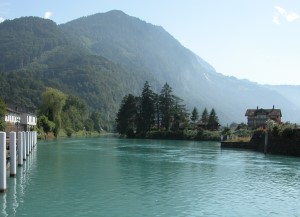


  Interlaken Travel guide, Interlaken hotels - holidays in Switzerland


  Interlaken Travel information

Interlaken (570 m), though originally the stomping ground of some wayward Celts, was taken over by the Romans in 58 B.C.. These conquerors gave it the Latin name "Interlacus," meaning "between the lakes." The Germanic tribes over-ran Switzerland a little more than three hundred years later, and it was specifically the Alemanni who moved into the valley in 260 A.D.. Sometime during their heyday the name was mutated to "Inder-lappen." All of Switzerland came under Frankish rule during the sixth century, but the Franks had little effect on an area already well ensconsed in the Germanic language and culture.

In 1133, an Augustinian monastery was founded and given the strangely familiar name of "Interlacus." The monks gained power by buying up all of the surrounding lands, during the next few centuries eventually becoming the biggest landowners in all of the Berner Oberland. The concept of feudalism was alive and thriving.

Around the year 1280, Count Berchtold of Eschenbach got permission to build a town on lands rented from the monastery. His town, just over on the other side of the River Aare, became known as "Unterseen," also "between the lakes."

In 1528, the Augustinians and indeed all the people living on their lands were forced by the Reformation to give up their Catholicism. Not as well documented is the fact that the subjects of the monastery actually took up arms against Bern in what was known as the "Inderlappen War." Perhaps because they lost.

In 1860, just on the heels of the 1859 opening of the Kursaal (spa), the huge central park known as the Höhematte (high field) was bought by a group of thirty-seven hotel owners. They wanted to keep the area open, so that tourists would always have a good view of the snow-capped Jungfrau, to the south. By the mid-eighteen hundreds, the town was already a popular spa. (Clean mountain air apparently wasn't the only rejuvenative elixir offered; one source also spoke of a "goats' milk cure," but it was unspecific as to whether the milk was consumed or wallowed in.)

By this time, the name "Aaremühle," or "Mill on the River Aare," was used alternately with "Interlacus" and "Inderlappen," but in 1891, the town name was officially changed to "Interlaken." (Oh, what a relief.) But, before we put all confusion aside, I should also mention that the term "Bödeli" is also used in a lot of place names and names of businesses. It means "little floor" and refers to the entire flood plain lying between the lakes.

Bödeli has two castle ruins, Weissenau and Unspunnen, both situated about forty-five minutes' walk from the centre of Interlaken. Weissenau was built in the 12th century by Friedrich Barbarossa and probably operated to collect tolls from boats passing through the waterways that linked the lakes. It's located on the shore of Lake Thun, in what is today a nature preserve. The ruin of Unspunnen, also built in the 12th century, is nestled on a hillside to the southwest of Interlaken. Burkhard of Unspunnen was its earliest known resident, and it was later occupied by the Knights of Wädiswil. Since it commands an excellent view of the valley and the high mountains beyond, it's no wonder that Lord Byron selected this castle as the setting for his play "Manfred," which he conceived at nearby Wengernalp in 1816. If you have only a few hours in Interlaken, the ruins make excellent walking or cycling destinations.

  Interlaken Sights, sightseeing, culture:

Nestling cosily beneath the legendary triad of the Eiger, Mönch and Jungfrau mountains, Interlaken, 570 metres above sea level is a wondrous health resort and an international favourite. The superb mountainous scenery and gentle climate are ideal venues for virtually every leisure activity, all year round. Interlaken shimmers like a jewel between the lakes of Brienz and Thun.

Höheweg, broken in the middle by Höhematte is the business and social centre of Interlaken. The shopping is varied and interesting from simple souvenirs to luxurious timepieces. Grand hotels and inviting restaurants and cafes to spoil the visitor abound whilst a traditional horse-drawn carriage ferries guests to and from their destinations in fine style. The famous Kursaal - Interlaken's casino is situated in the centre of Höheweg. Here you can find many types of entertainment including elegant balls, annual music festivals, Folklorica, local and trade shows in addition to the obvious delights of the casino tables. Interlaken is also an ideal starting point for excursions to the Bern upperlands and breathtaking Jungfrau region with the centrepiece's massive peak soaring 4158 metres into the cloudless skies.

  Interlaken luxury hotels 5*:

interlaken hotelsInterlaken Hotel 5*
 
interlaken hotelsInterlaken Hotel 5*
 

  Interlaken first class hotels 4*:

interlaken hotelsInterlaken Hotel 4*
 
interlaken hotelsInterlaken Hotel 4*
 
interlaken hotelsInterlaken Hotel 4*
 
interlaken hotelsInterlaken Hotel 4*
 
interlaken hotelsInterlaken Hotel 4*
 

  Interlaken budget hotels 3*:

interlaken hotelsInterlaken Hotel 3*
 
interlaken hotelsInterlaken Hotel 3*
 
interlaken hotelsInterlaken Hotel 3*
 
interlaken hotelsINTERLAKEN Hotel 3*
 
interlaken hotelsInterlaken Hotel 3*
 
interlaken hotelsInterlaken Hotel 3*
 
interlaken hotelsInterlaken Hotel 3*
 
interlaken hotelsInterlaken Hotel 3*
 
interlaken hotelsInterlaken Hotel 3*
 
interlaken hotelsInterlaken Hotel 3*
 

  Selection of GUT rated hotels in Interlaken:

All Displayed Prices Exclude Tax Recovery Charges and Service Fees

interlaken hotelsInterlaken Hotel 2*
 
interlaken hotelsInterlaken Hotel 2*
 
interlaken hotelsInterlaken Hotel 2*
 
interlaken hotelsInterlaken Hotel 2*
 
interlaken hotelsInterlaken Hotel 2*
 
interlaken hotelsInterlaken Hotel 2*
 
interlaken hotelsInterlaken Hotel 2*
 
interlaken hotelsInterlaken Hotel 2*
 
interlaken hotelsInterlaken Hotel 2*
 
interlaken hotelsInterlaken Hotel 2*


Athens Hotels | Korfu | Kreta | Mykonos | Rhodos | Santorini | Greece Travel Guide | Laser cutting machines | Greece vacation Packages | Meteora & Delphi Tours | About Us | Contact Us |
