Krakow Travel guide, Krakow hotels, vacation
Cracow was mentioned for the first time in a report of Ibrahim-Ibn-Jakub, a merchant from Cordoba, in the year 985. He describes a rich city on the crossing of trade routes, which was surrounded by forests.
Archaeological findings provide evidence that the Wawel Hill was settled as far back as the early Stone Age. The Mounds of Krakus and Wanda, legendary rulers of the settlement inhabited by the Slavonic tribe of Wislanie, probably date back to the 7th century.
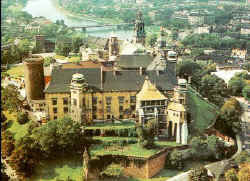
Krakow Travel guide, Krakow hotels - holidays in Poland
Krakow Travel information
In the pre-Piast period, two dates from the city's history are known. Between 876 and 879, Swietopelk, Duke of Grand Moravia, occupied the region what was later to be named "Little Poland". After 955 Boleslaw the Cruel, the ruling Czech Duke, brother of St. Vaclav, introduced Czech rule here. In the 10th century Cracow was incorpo rated into the Polish state. However, it is difficult to say for sure whether it occurred during the rule of Mieszko I in 990 or Boleslaw Chrobry in 999.
Krakow in the Middle Ages
Certain facts and dates from the city's history can only be given after the year 1000. A castle and a borough existed then on the Wawel Hill, which were fortified with a palisade and an earth wall. In the 10th and 11th centuries the first brick edifices were built (the castle and Romanesque churches) and the cathedral and a basilica, as well as the St. Feliks and Adaukt Church. In the year 1000 a bishopric was established in Cracow. In 1150 a cathedral school, the best educational establishment in Poland before the foundation of the University, was set up at the castle church. In the cathedral treasury the regalia (the crown and sceptre of Boleslaw the Brave) were kept. A rich library, which had 28 books, included classic literature along with the religious works - comedies by Terence, elegies by Ovid, and historical monographs by Sallust.
In 1142 the Robert consecrated the "second" Wawel cathedral, which had been built to replace the destroyed Romanesque church. The body of St. Stanislas, after it had been moved from the church at Skalka, and the relicts of St. Florian, were solemnly laid to rest at the new cathedral.
The feudal division of Poland and continuous fighting between regional dukes did not interrupt the city's rapid development. In 1138 Cracow Castle became more important as the official home of the highest duke and, to some degree, the capital of Poland, according to the last will of Boleslaw the Wry-Mouthed. New ones built in Gothic style replaced the buildings de stroyed during the invasion of the Tatars in 1241. The location of the city according to the Magdeburg law in 1257 gave it a new layout with a centrally situated marketplace. In the 13th century the city was provided with a new fortification system of city walls, towers and fortified city gates. This system was gradually added to and modernized over the next centuries. On 20th January, 1320, the first coronations fol lowed this one during the next five centuries. The cathedral also became the Royal burial site.
The reign of Kazimierz the Great, patron of the arts and sciences, proved to be of great importance for the city. The king founded two new cities, Kazimierz and Kleparz, which were closely connected with Cracow. Gothic, Franciscan and Dominican churches were built and St. Mary's Church, as well as the Corpus Christi Church and St. Catherine's Church in Kazimierz. Renovation of the cathedral and castle on the Wawel Hill, and the Cloth Hall, Townhall and other public buildings was continued. In 1364 Kazimierz the Great founded the Cracow Academy, which was the origin of the later Jagiellonian University.
Wladyslaw Jagiello, Grand Duke of Lithuania, was crowned King of Poland in 1386 and started the greatest Polish dynasty, which ruled Poland for over 200 years. Cracow became the capital of a monarchy spreading over genuinely Polish territories as well as vast Lithuanian-Russian areas. The royal court played an important role in sup porting artistic and cultural life. Outstanding humanists, scientists and artists came here from Italy, Germany and other countries. Veit Stoss, famous sculptor, came from Nurnberg in 1477 to carve a large altar for St. Mary's Church on the citizens' order. After further rebulding between 1499 and 1536, Wawel Castle was a pearl of Renaissance architecture, boasting the "Zygmuntowska" Chapel - the most beautiful sepulchral chapel in Poland. The castle was decorated with a collection of Arras tapestries ordered from Flanders. It proudly played the role of the royal seat of a powerful country well up in the fashionable world of its time.
In 1702 the city was seized and devastated by the Swedish army again. Wawel Castle burnt down. The following invasions of Prussian and Russian troops made the destruction complete.
Due to the first partition of Poland in 1772, the Austrian army seized the southern part of Little Poland. On 24th March 1794 Kosciuszko's Insurrection began in Cracow. Temporarily included into the Warsaw Duchy, it was given the status of a "free city" after Napoleon's downfall. Cracow developed rapidly. The "Planty" )a green land ring) was set up in place of the city walls (which had been pulled down). New districts developed on the city outskirts. After the defeat of the November Insurrection (1831), Cracow preserved its autonomy as the only part of Poland. In 1846 it was included into the Austrian Monarchy again. De spite being under foreign control, the city enjoyed some freedom. At that time Cracow became the symbol and centre of Polish traditions and the spiritual capital for all parta of divided Poland. Scientific and cultural establishment developed dynamically. The Scientific Association of Cracow (Towarzystwo Naukowe Krakowskie) was the ori gin of the Academy of Sciences. In 1818 the Academy of Fine Arts was established and in 1854 the Society of the Friends of Fine Arts.
Krakow in the 20th century
The approaching war against Russia prompted the growth of independence movements. In 1910 the paramilitary "Strzelec" (Rifleman) Association was founded. Almost all political parties could act legally in Cracow. On 6th June 1914 the First Company of "Strzelcy" under the command of Jozef Pilsudski set off from the "Oleandry" of Cracow.
After independence had been regained in 1918, Cracow became a significant administrative and cultural centre. Industry started to develop rapidly.
Although the Second World War did not destroy the historical monuments, it ravaged the city in other ways. On 6th November 1939 professors of the Jagiellonian University and the most outstanding representatives of the city's intellectual elite were arrested and transported to the concentration camp in Sachsenhausen.
After the war Cracow lost its privileged position. The communist authorities wanted intellectual circles dominated by the working class. This purpose was to be fulfilled by the construction attracted workers to Cracow in their masses. How ever, it is the artistic and scientific circles that create the image of the city, which has now over 800 thousand inhabitants.
Krakow Sights, sightseeing, culture:
Annually, every first Thursday following Corpus Christi day a large crowd of people gathers in the Premonstratensian monastery yard in the Zwierzyniec district. Some men are dressed in the traditional Cracovian folklore dress while others adorn oriental garments a hold horse - tail insignia in their hands. A musical troupe called "The Mlaskoty" stands close by playing drums, flute bugle, clarinet, fiddle, and double bass. The "Lajkonik" enters the yard while the troupe plays loud and high-pitched music. The hero of the festivity - Lajkonik- rides a hobby - horse with peacock feathers attached to its head and in Tartar disguise through the streets of Cracow. This magnificent costume is an extremely accurate copy of the dress designed by Stanis³aw Wyspiañski in 1904. After paying a courteous visit at the Premonstratensian monastery and parish priest the Lajkonik leads the pageant trough the Cracow streets: Ko¢ciuszki, Zwierzyniecka, Franciszkañska, and Grodzka to the Main Market. This procession lasts about 2-3 hours. At 6 p.m., in front of the Old Tower Hall on the Main Market the Lajkonik with the colours flying and music blasting dances and prances merrily around. Usually dinner at the Hawe³ka Restaurant ends the festivities.
A type of outdoor fair and market taking place on Tuesday after Easter in the vicinity of the Benedictine church on top of the Lasota Hill in Podg�rze. Today this festivity is usually limited to stands selling gingerbread, sweets, cheap souvenirs and toys with some shooting galleries and a fun fair. In the past it was different. According to the 1475 Hetman Volumes, Stanis³aw Sarnicki describes the ancient tradition of planting trees around the grave of Rêkawka, bonfires and fencing contains. The name "Rêkawka" quite probably derives from the world "rêkaw" meaning sleeve -as in sleeves people carried the soil to the grave of Krakus.
The festivities were transferred from the foot of the Krakus Mound after Cracow was annexed by Austria. During the old times, the poor were given food but Austrian authorities forbade this tradition in 1897. What remains is only the fair. On Easter Monday at the church of St. Salwator in Zwierzyniec St. Luke's gospel is read about the pupils of Emaus: "And behold, two of them travelled to the town called Emaus as far as 60 stadiums from Jerusalem. And between each other they talked of all matters that ever happened. Then it became, that while they were talking and asking each other did Jesus approach them and walk with them. Their eyes veiled so they could not recognize Him. [ "This church had been named Emaus for a long time in the past or more familiar "Hemaus". This festivity is an occasion for infinite crowds of Cracovians and visitors to arrive at the folk garden party and fair. Fair stands and stalls are set up along the whole length of the Ko¢ciuszko Street reaching the bridge over the Rudawa River. Hordes of passerbyes are soaked in water being poured at them. Easter Monday is called "Wet Monday". Since 1976, the Emaus festivity has been organized under the auspices of the Historical Museum of Cracow. Every year on St. John the Baptist's Day and Wanda's name-day (23rd and 24th June) the tradition of Wreaths is celebrated along the Vistula River banks at the foot of the Wawel Hill This festivity changed after the Second World War. However, the common elements are amateur and professional folklore group performances on a stage erected close to the Wawel Castle, floating lit wreaths on the Vistula River and fireworks display. Annually, this event gathers enormous numbers of Cracovians and guests between Wawel and the Dêbnicki Bridge. The genesis of this tradition is ancient and a sum of three customs: Sobtka (bonfires traditionally lit by country-folk on Midsummer Day, searching for the magic fern flower and in commemoration of Wanda - the legendary daughter of Krakus
Krakow luxury hotels 5*:
Krakow first class hotels 4*:
Krakow budget hotels 3*:
Selection of GUT rated hotels in Krakow:
All Displayed Prices Exclude Tax Recovery Charges and Service Fees
Krakow Hotel 5*
Krakow Hotel 5*
Krakow Hotel 5*
Krakow Hotel 5*
Krakow Hotel 5*
Krakow Hotel 5*
Krakow Hotel 5*
Krakow Hotel 3.5*
Krakow Hotel 3.5*
Krakow Hotel 4*
Krakow Hotel 4*
Krakow Hotel 4*
Krakow Hotel 4*
Krakow Hotel 4*
Krakow Hotel 4*
Krakow Hotel 4*
Krakow Hotel 4*
Krakow Hotel 2.5*
Krakow Hotel 2.5*
Krakow Hotel 2.5*
Krakow Hotel 3*
Krakow Hotel 3*
Krakow Hotel 3*
Krakow Hotel 3*
Krakow Hotel 3*
Krakow Hotel 3*
Krakow Hotel 3*
Krakow Hotel 1.5*
Krakow Hotel 2*
Krakow Hotel 2*
Krakow Hotel 2*
Krakow Hotel 2*
Krakow Hotel 2*
Krakow Hotel 2*
Krakow Hotel 2*
Krakow Hotel 2*
Krakow Hotel 2*
